


- HKC&ED News
- HKC&ED News

- Enforcement News
- FATF
- Industry News
- Industry News
- Telephone Deception
- E-mail Scam
- Trade Descriptions Ordinance
- Download
- Video
- Links
US dollar peg is still doing its job - 30 years on
2013-10-17
■US dollar peg is still doing its job - 30 years on
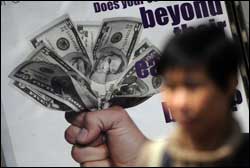
Today marks the 30th anniversary of the Linked Exchange Rate System, which was introduced on October 17, 1983.
For 30 years, the LERS has been the cornerstone of Hong Kong's monetary and financial stability. The system has been tested through different economic cycles and financial crises, and has continued to work well for us. Today, it is an integral part of our daily life.
After all these years, some of us may have only vague memories of the anxiety in the community when the Hong Kong dollar exchange rate depreciated sharply before the adoption of the LERS.
Some in the younger generation may not have even heard about that period.
Let me restate the system's benefits and its importance to Hong Kong.
In 1983, Hong Kong had a floating exchange rate system. The Sino-British negotiations on the future of Hong Kong were going on, and there was rapid deterioration in market confidence over the economy and the Hong Kong dollar.
This sentiment led to sharp depreciation of the Hong Kong dollar from US$1 to HK$6.50 in early June 1983 to US$1 to HK$8.36 on September 21, and then to US$1 to HK$9.60 on September 24. People worried about the depreciation and scrambled for groceries and food staples. Even toilet paper became a target of panic buying.
I was then the assistant district officer in Sha Tin responsible for community development, having just joined the civil service. This experience left a deep impression on me.
It was against this background that the LERS was introduced. The community calmed down and the Hong Kong dollar was effectively stabilized.
This incident clearly showed how a stable exchange rate is closely related to our community's daily life.
The system has maintained exchange rate stability and has provided a stable monetary and financial environment that is crucial to the trade-dependent Hong Kong economy.
Our import and export trade transactions are mostly in US dollars. With the Hong Kong dollar pegged, it is much easier for businesses to estimate their costs and determine pricing, since they need not worry about potential losses due to fluctuations in the rate. They can also save costs for hedging against exchange rate volatility.
The stable rate has provided a favorable environment for Hong Kong to develop into an international trading hub. Our external trade increased from 190 percent of gross domestic product in 1983 to the current 450 percent, and the number of employees in this sector has reached 30 percent of the working population.
The stable rate has also provided an important platform for development as a financial center. The US dollar is a commonly used international currency, and most international investors have US dollar holdings for investment. Their returns are often calculated in US dollars. The units or shares of many hedge funds and mutual funds around the world are US dollar-denominated.
Most investors trading in Hong Kong equities need not hedge their currency exposure. In the past three decades, the total assets of our banking sector and our stock market capitalization have grown by 13 times and 152 times respectively, bringing growth to many service sectors such as accounting, legal services and other professional services.
The stable environment has also been crucial in supporting economic growth. Hong Kong's GDP increased by nearly 10 times during this period and our per capita GDP has reached HK$290,000 per annum.
With the upgrading of our credit rating to AAA in 2010, Hong Kong is one of just 14 economies to have achieved that grade. Although the LERS is not an inflation-targeting currency regime, our inflation is comparable to those of other economies.
The inflation rate in Hong Kong last year was similar to the rates found in other economies in the region. The unemployment rate remains low at 3.3 percent, a level of full employment.
The LERS is a simple, clear, highly transparent and rule-based system.
It is readily understood by the market and the public. Under the LERS, Hong Kong has weathered a succession of challenges.
These include the 1987 stock market crisis, the Gulf War in 1990, the European Exchange Rate Mechanism crisis in 1992, the Asian financial crisis in 1997-98, the bursting of the dotcom bubble in 2000, the SARS epidemic in 2003, the global financial crisis sparked by the US subprime mortgage bubble in 2007-08, and the more recent sovereign debt problems in Europe.
No exchange rate regime is perfect. Some people think the LERS is the main culprit in Hong Kong's recent asset price inflation brought about by the quantitative easing in the United States. It is important to note that jurisdictions with a flexible exchange rate are also not immune to the spillover effect of the monetary policies of the major economies.
Hong Kong, being a small and open economy, is no exception. But the LERS has helped to minimize the shocks.
Take Switzerland. It saw huge inflows of funds when the sovereign debt problems intensified, buoying the rate of the Swiss franc. Some may feel a stronger currency means a rise in wealth of the people in foreign currency terms.
However, the reality is the opposite. Appreciation of the Swiss franc dampened exports and hit tourism. Growth stalled and deflationary pressure emerged. In the end, the Swiss central bank set an upper limit for the Swiss franc exchange rate.
Following the outbreak of the US subprime mortgage crisis, emerging market economies generally faced the pressure of fund outflows. But in Hong Kong we have witnessed many investors parking their funds here, which contributed to the strengthening of the Hong Kong dollar in late 2008 to 2009.
Quantitative easing in the US and the Fed's recent remarks about its exit have caused big fluctuations in regional currencies. Some economies had to impose capital controls to defend against the volatile fund flows.
The Hong Kong dollar, on the contrary, has been stable, reflecting market confidence in the LERS and the lack of speculative interest in our currency.
The recent fall in foreign exchange turnover involving the Hong Kong dollar is also a sign of the low level of speculative activities.
The success of the LERS hinges on several important prerequisites.
First, we have a flexible economic structure in which internal prices, costs and wages can adjust to external changes, thereby ensuring Hong Kong's competitiveness.
Second, our banking system is robust, well capitalized and highly liquid, so it can readily withstand external shocks.
Third, under the government's prudent fiscal policies, the LERS is not affected by the debt or fiscal deficits of the government.
Fourth, our foreign reserves provide a strong backing for the LERS and financial stability.
The government will strive to maintain these conditions and ensure continued market and public confidence in the LERS.
Hong Kong still faces many external challenges ahead.
In particular, the exit from quantitative easing in major economies may result in volatile fund flows.
We are upholding the LERS not because we just want to maintain the status quo. More importantly, we are doing so because we strongly believe it is still the most appropriate monetary system for Hong Kong in light of the challenges ahead.
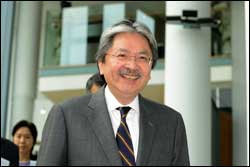
The government sees no need and does not intend to change the LERS. John Tsang Chun-wah is Financial Secretary