


- HKC&ED News
- HKC&ED News

- Enforcement News
- FATF
- Industry News
- Industry News
- Telephone Deception
- E-mail Scam
- Trade Descriptions Ordinance
- Download
- Video
- Links
Hand of Central Bank Seen behind Sudden Weakening of Yuan
2014-02-20
The spot trading exchange rate of China's currency against U.S. dollar hits nearly two-month-high on February 19
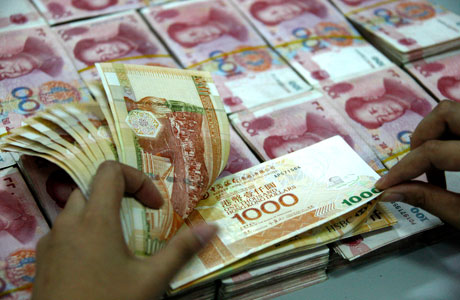
■(Beijing) – A sudden weakening of the yuan this week has fueled discussion about whether the central bank was paving the way for a more flexible exchange rate system.
On February 19, the spot trading exchange rate of the yuan against the U.S. dollar reached a nearly two-month-high, at 6.0772. It closed at 6.0764, up 91 basis points from the previous day, depreciation of 0.15 percent.
The central parity rate of the exchange rate set by the central bank that day was 6.1103, mild depreciation from the 6.1050 on January 30.
On February 18, the yuan's offshore 12-month non-deliverable forwards were trading at around 6.1080, showing that investors expected the yuan to appreciate only slightly in a year.
Many analysts said they saw evidence the central bank was intervening.
"The yuan has weakened since the Spring Festival, and it should be the central bank's will at work because the U.S. dollar has strengthened," a forex trader at a state-owned bank said.
He also said the central bank may be trying to break foreign speculators' expectation of guaranteed profit from a more expensive yuan.
The central bank has said it would encourage the yuan to fluctuate both ways as it approaches an equilibrium level. Guan Tao, an official at the State Administration of Foreign Exchange under the central bank, restated the position in January saying that "We cannot keep on adjusting (the yuan exchange rate) one way all the time."
The bank also posted an article on its website this week, saying its job this year includes orderly broadening the yuan's fluctuation range.
This came after financial information provider Bloomberg quoted an analyst saying the regulator may increase the band from 1 percent on either side of the central parity rate to 2 percent. The bank did not confirm the report.
Liu Dongliang, an analyst with China Merchants Bank, said a wider fluctuation band alone would not necessarily change the market's expectation of the yuan's exchange rate because it is mostly driven by the central parity rate.
"Unless the bank lets the market have more power in deciding the central parity rate, the expectation for one-way appreciation would not disappear," he said.