


- HKC&ED News
- HKC&ED News

- Enforcement News
- FATF
- Industry News
- Industry News
- Telephone Deception
- E-mail Scam
- Trade Descriptions Ordinance
- Download
- Video
- Links
Yuan’s global payments share at four-month high
2015-5-28
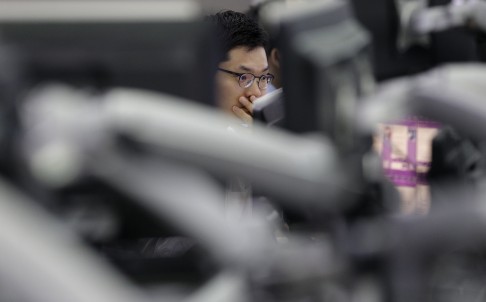
■ A currency trader in Asia keeps an eye on exchange rate as the market share of China currency in the global payment system increased to its highest level in four months
The market share of China’s currency in the global payment system grew to a four-month high in April, cementing the yuan’s position as the world’s fifth-largest payment currency by value and providing further proof that it is on track for wider acceptance.
The yuan accounted for 2.07 per cent of the value of global payments tracked by Swift (Society for Worldwide Interbank Financial Telecommunication) last month, up from 2.03 per cent in March and slightly below the peak of 2.17 per cent in December, Swift said in a monthly report released yesterday.
Swift is an interbank messaging network provider through which the majority of international banks and corporations settle trades and investments.
The yuan’s market share is still tiny when compared with the US dollar and euro, the top two payment currencies, which accounted for 45.14 per cent and 27.36 per cent of global payments by value last month.
However, growth has been robust, in particular when looking at the increasing willingness to settle yuan in the payments between companies based in China, including Hong Kong, and the rest of countries in the Asia-Pacific region, the report said.
“Big trading partners like Singapore, Taiwan and South Korea have adopted the renminbi for the majority of their payments with Greater China. The new appointments of four clearing centres (South Korea, Malaysia, Thailand and Australia) within the region should also have a positive impact on renminbi adoption, solidifying the important role of the currency within Asia-Pacific and abroad,” said Michael Moon, head of payments Asia-Pacific at Swift.
Two years ago, only 7 per cent of payments between China and the rest of Asia were denominated in yuan. Now the ratio has gone up to 31 per cent.
It has replaced the Japanese yen to become the most popular currency when Asian companies do transactions with Chinese companies.
By value, the payments exchanged between China and the Asia-Pacific increased by 327 per cent between April 2012 and April 2015, the report showed, without disclosing the absolute figure.
In a recent renminbi survey of corporates by HSBC, usage of the yuan has become a topic of debate in more than a fifth of company boardrooms around the world, said Vina Cheung, HSBC global head of renminbi internationalisation.
More than half of all the businesses surveyed expect to increase their cross-border trade with China in the next 12 months, the survey found.
Analysts say the future driver of more adoption of the renminbi will no longer be the expectation of appreciation but China’s pace in opening up its capital market and encouraging more foreign investment in the onshore market.
Separately, the People’s Bank of China set the midpoint rate at 6.1198 against the US dollar, the weakest level since April 28. The yuan has appreciated 33 per cent against the dollar since Beijing started foreign exchange reform in 2005 by allowing the currency to gradually gain.
On Tuesday, the International Monetary Fund for the first time declared that the currency is “no longer undervalued”, countering previous criticism from the Western world that China has been manipulating its currency to win competition for its exporters.
Source: South China Morning Post